Loading story
UPI MDR charges proposal
National · 34 updates
‘Someone has to pay’: RBI governor on MDR proposal for UPI transactions above Rs 2k
According to official estimates, the Rs 2,000 threshold would cover only around 5% of all UPI transactions, although these account for nearly 65% of the total value processed on the platform. As a result, routine purchases such as milk, vegetables, groceries, or payments for auto-rickshaws and taxis are unlikely to be affected. UPI processed 23.7 billion transactions worth Rs 29.9 lakh crore in July.
UPI MDR: What could happen to Rs 2,000+ payments
Charges On UPI Transactions? RBI Governor Says 'Costs Have To Be Paid By Someone'
RBI Governor Sanjay Malhotra underlined the economics underneath UPI at a press conference.
UPI Charges Debate Grows, RBI Governor Says MDR Proposal Is Still At An Early Stage
Consumers already bearing UPI costs indirectly: RBI governor
RBI governor Sanjay Malhotra emphasized that the costs of UPI transactions are already subtly included in operations. He expressed it is premature to introduce explicit fees for merchants. The priority lies in enhancing the payment infrastructure and increasing utilization. Any fee implementation should consider potential effects on user engagement and ongoing investment, as consumers do indirectly incur costs, albeit often unnoticed.
UPI MDR Return May Strengthen PhonePe, Google Pay & Paytm’s Merchant Dominance
Taxation bill clears Lok Sabha, allows provision for MDR on UPI transactions
Under the proposed changes, the Central government would be empowered to specify, through a notification, the electronic payment modes or transactions that must continue to remain free of charges.
Will you have to pay to use UPI? FM Sitharaman clarifies who bears MDR
In a recent statement, Finance minister Nirmala Sitharaman emphasized that UPI transaction charges will be applicable to merchants rather than customers. She explained that any Merchant Discount Rate (MDR) imposed would be instrumental in enhancing the digital payment ecosystem. Following the passage of an amendment bill in Parliament, a committee will investigate the adjustments to the zero-MDR policy for digital payments.
Will you have to pay to use UPI? 7 FAQs on possible MDR & what it means for consumers
The government is expected to permit a Merchant Discount Rate (MDR) of between 0.25% and 0.4% on UPI transactions above Rs 2,000 made to businesses, while person-to-person payments are likely to remain outside the scope of the proposed levy. The proposal is not expected to affect routine purchases such as milk, vegetables, groceries or payments for auto-rickshaw and taxi services.
UPI’s zero-MDR edge could be India’s weak link
UPI Payments To Remain Free For Consumers, Says PhonePe CEO Sameer Nigam
Proposed MDR for UPI transactions will be nominal, says government
The government has pledged that the upcoming UPI merchant discount rate will be minimal. This fee will be applicable only to certain merchants and transactions that surpass a designated threshold. Importantly, person-to-person UPI payments will remain free for all users. This initiative is designed to enhance the sustainability of India’s digital payment ecosystem and facilitate service expansion into rural and semi-urban regions.
UPI stays free for users, vast majority of transactions to remain free for merchants as well, says government
The government said any future merchant discount rate (MDR), if introduced, would apply only to a limited set of merchant transactions above a specified threshold and at a nominal rate, which would be lower than typical debit and credit card MDRs
No UPI Charges For Users, But Nominal MDR May Apply To Select Merchant Payments: Government
Is UPI ending free payments for all users?
UPI payments will not attract any tax or transaction charge: FM Sitharaman
Finance Minister Nirmala Sitharaman clarified that the Taxation and Other Laws (Amendment) Bill does not impose any tax or transaction charge on UPI payments. She said the proposed amendments do not introduce any additional cost on UPI transactions.
Watch: UPI payments will remain free: Nirmala Sitharaman
Parliament passed the Taxation and Other Laws (Amendment) Bill, 2026, with Finance Minister Nirmala Sitharaman clarifying that the legislation does not impose any tax or transaction charge on UPI payments. The Bill also seeks to attract foreign investment, promote domestic electronics manufacturing and ease operations for foreign cloud companies and fund managers in India.
UPI MDR: What is being proposed, and who pays the final cost? Explained
The government has clarified that UPI will continue to remain free for consumers and no transaction charges will be applicable to person-to-person payments. The government has also said that if an MDR is introduced in the future it will only be applicable to a limited category of merchant transactions.
UPI MDR Could Return On High-Value Transactions As Govt Mulls Tiered Incentives
UPI fee rollback ruled out, 0.4% MDR to stay
Amid Opposition attacks on the government’s decision to levy a fee on UPI payments above Rs 2,000 made to merchants, government sources said there is no plan to reconsider the 0.4% Merchant Discount Rate (MDR) on such transactions, PTI reported on Wednesday.The decision has drawn strong opposition from several quarters, including traders, shopkeepers and political parties, which have dubbed the move the 'Modi Tax'.A top official, when asked whether the government was considering rolling back the proposed MDR on UPI transactions above Rs 2,000 from October 15, said a decision had already been t
"No Foreign Influence": On UPI Charges, Centre Trashes Opposition's Claim
The Congress attacked PM Modi and termed the charge "UPI tax", a characterisation the Centre countered.
‘Think twice about accepting cash’: Retailers' body on new UPI merchant fee
Retailers body warned that the UPI fee "could undo years of progress in digital payment adoption" among India's smallest retailers.
Sameer Nigam on UPI MDR: 'We Don't Want Subsidies From The Government'
Sameer Nigam on UPI MDR: 'We Don't Want Subsidies From The Government'
SEBI To Review Stockbrokers’ Concerns Over New UPI MDR Charges On Market Transactions: Tuhin Kanta Pandey
'UPI tax proposal not discussed': Congress MPs on House panel deny backing MDR
Congress MP Manish Tewari called out the government for allegedly using "proceedings of Parliamentary Standing Committees to score brownie points".
Mumbai Petrol Pumps Threaten To Stop UPI Payments From October 15 Over Revised MDR
Congress disputes Parliamentary panel chief’s claim on levying UPI MDR
Congress MP Manish Tewari, a member of the committee, said the suggestion that Opposition members had endorsed the proposal by not recording a dissent was ‘unfounded and unfortunate’
Traders’ forum in Keralam to boycott UPI transactions on October 15
UPI MDR: Can Rs 6,000 be split into three Rs 2,000 payments? No daily cap
The NPCI framework and the FAQs issued with it do not stipulate that multiple payments relating to a single bill must be clubbed together. Such a restriction, if in place, could prevent businesses from breaking up larger payments into multiple transactions of Rs 2,000 or less.
UPI’s new MDR pot gets a small merchants twist
MDR on UPI: Keralam hotels association says will stop accepting UPI payments above ₹2,000 from October 15
Announcement following introduction of 0.4% UPI merchant discount rate, which the association says will impose additional financial burden on small establishments
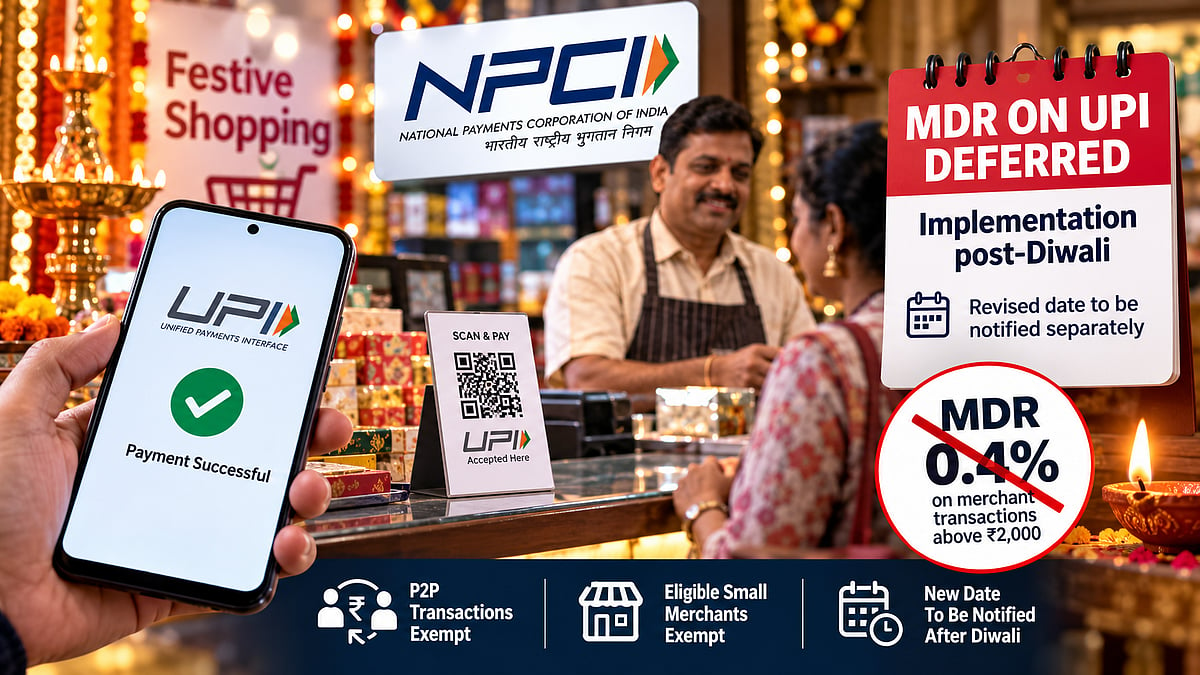
No need to pay UPI charges till Diwali celebrations
UPI MDR Charges Deferred Until After Diwali By NPCI; Mumbai Traders Welcome Relief From 0.4% Fee
Loading more stories…